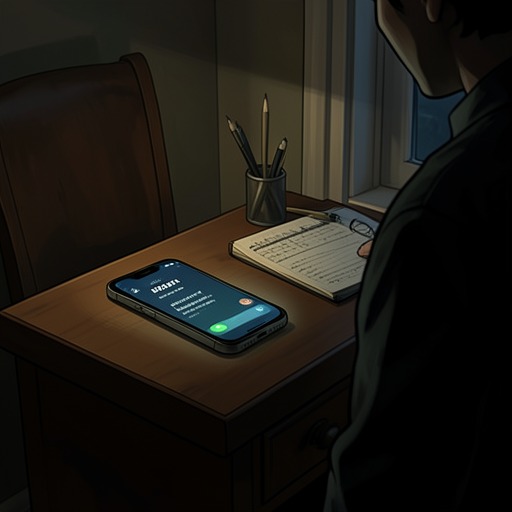
The Caller
I'm Thinking of Ending ThingsThe Caller is an unidentified man whose calls turn a plausible mistake into a private and increasingly disturbing mystery for The narrator. His voice and repeated messages offer clues but no stable explanation: he sounds sad rather than openly threatening, calls from The narrator’s own number, and claims knowledge of her appearance and nail biting. When she finally confronts him, he says the matter is about her and that he cannot help her, deepening the sense that the calls concern her without revealing his identity or purpose.
Identity and First Contact
The Caller first reaches The narrator on the night she meets Jake at the Pub. At first, the call seems ordinary enough to dismiss: she explains that he has the wrong number, and he answers, “I’m sorry,” before waiting a beat or two and hanging up. What distinguishes the exchange is his voice. The narrator hears a man, middle-aged at least and probably older, speaking with a strained timbre and subdued, gradual delivery. Its distinctly feminine intonation sounds almost as if he is raising his pitch or adopting a delicate, flat manner; the voice is also unpleasantly distorted. She does not recognize it and cannot identify him, even after listening to the first message repeatedly for signs of familiarity.
That initial apology does not resolve the mistake. The next day, The narrator finds two missed calls from the same number, both received while she was asleep. The number is her own. She checks the missed-calls list again because she initially suspects an error, but confirms that the calls really do appear to have come from her phone number. The impossible-seeming detail changes the calls from an unexplained callback into a problem she cannot account for, although the evidence does not establish how the calls are made or who is behind them.
A Repeated Pattern
The Caller’s contact develops over several days rather than arriving as a single startling message. Three or four days after the first call, he leaves his first voicemail. The narrator keeps that recording, along with every subsequent one; there are seven in all. She considers that she may eventually tell Jake, but does not initially share the calls with him. The Caller therefore becomes a secret running alongside her new relationship with Jake, one of the few unusual things she identifies as happening in her life.
The calls continue to arrive in the middle of the night, often around 3:00 a.m., when The narrator is asleep. She wakes and finds another missed call, again from her own number. The timing makes the intrusion recur in the vulnerable interval between sleep and waking, while the repeated number refuses the usual distinction between an outside caller and her own device. The messages are not described as plainly aggressive, and the voice is not unmistakably threatening. Their sadness, and perhaps frustration, is more apparent to The narrator than menace, though her judgment becomes less certain as fear accumulates.
The Messages and Their Knowledge
The Caller’s messages are always the same, word for word. Their language strikes The narrator as nonsensical, but not as mere babble: she cannot determine what the words mean, yet senses that they are being said deliberately. The fixed wording gives the recordings a quality unlike an ordinary series of spontaneous calls. Each new message repeats rather than clarifies, so the very consistency that might make the Caller easier to identify instead sustains the mystery.
One message makes the intrusion personal by addressing details of The narrator’s body and appearance: “I know what you look like. I know your feet and hands and your skin. I know your head and your hair and your heart. You shouldn’t bite your nails.” The final observation connects the Caller’s claim to a specific habit, not merely a vague assertion of familiarity. The passage supplies no explanation for how he knows this, and it does not establish whether his knowledge comes from observation, access to private information, or some other source. Its effect is to narrow the distance between the voice on the phone and the person being called: the Caller speaks as if The narrator is already known to him.
Confrontation
After deciding that she must answer the next call and tell the Caller to stop, The narrator gets her opportunity when the phone rings. Anger and fear accompany her questions about why he is calling, how he got her number, and whether he can keep doing this. She no longer treats the contact as a random dialing accident. In her understanding, the calls are not going to stop, the Caller is not going away, and he wants something from her; she cannot tell what that something is or why he has chosen her.
The Caller’s reply is brief: “This is about you. I can’t help you!” The statement confirms, at least in its wording, that The narrator is central to the matter, while refusing the explanation she is seeking. Its claim that he cannot help her complicates the apparent threat: he has spoken with intimate knowledge and persisted in contacting her, but presents himself not as someone able or willing to provide a solution. The narrator is yelling by the end of the exchange. The scene leaves the practical questions unresolved: his identity, the origin of the calls from her number, and the meaning of the repeated messages remain unknown.
Narrative Role
The Caller functions as a continuing source of uncertainty rather than as a fully disclosed character in the available account. The narrator receives and interprets the evidence from within her own fear: a strange voice, calls at night, the number matching her own, identical messages, and a detail about nail biting. Those concrete particulars make the Caller’s apparent knowledge difficult to dismiss, but they do not verify his identity or explain his access to it. His sadness and frustration sit uneasily beside the invasive intimacy of his words, preserving a tension between distress and menace.
The calls also establish a concealed strand in The narrator’s life with Jake. She recognizes that she should have told Jake or someone else when the contact began, but initially did not consider it significant; by the time the pattern feels serious, the omission itself has become consequential. The Caller is thus both an external mystery and a test of what The narrator shares with those around her. His repeated message and unresolved final response keep the central question open: the contact unmistakably concerns her, yet neither its cause nor its intended outcome is disclosed.